Drift Is a Choice. Poverty Is Not Always One: How Early Habits Can Quietly Wreck a Life Before It Starts
- Will D.B

- Mar 30
- 6 min read
It’s a harsh truth, but poverty isn’t always a choice. Structural factors like family income, school quality, health, neighbourhood conditions, discrimination and economic shocks all significantly impact life chances. OECD and Brookings research both demonstrate how socio-economic status influences educational outcomes and mobility.
However, another crucial truth is that drift is often a choice. Daily habits like doing the bare minimum, skipping effort, avoiding discipline, neglecting school and outsourcing responsibility can compound over years. These behaviours don’t explain every hardship, but they do explain why some people sabotage themselves long before adulthood fully begins. Research consistently links attendance, self-regulation, social-emotional skills and academic engagement to later outcomes.
This post presents the evidence-based argument that early habits matter immensely. It’s not because every struggling person is lazy or that hardship is deserved, but because the patterns formed in school years can either build leverage or quietly destroy it.
⸻
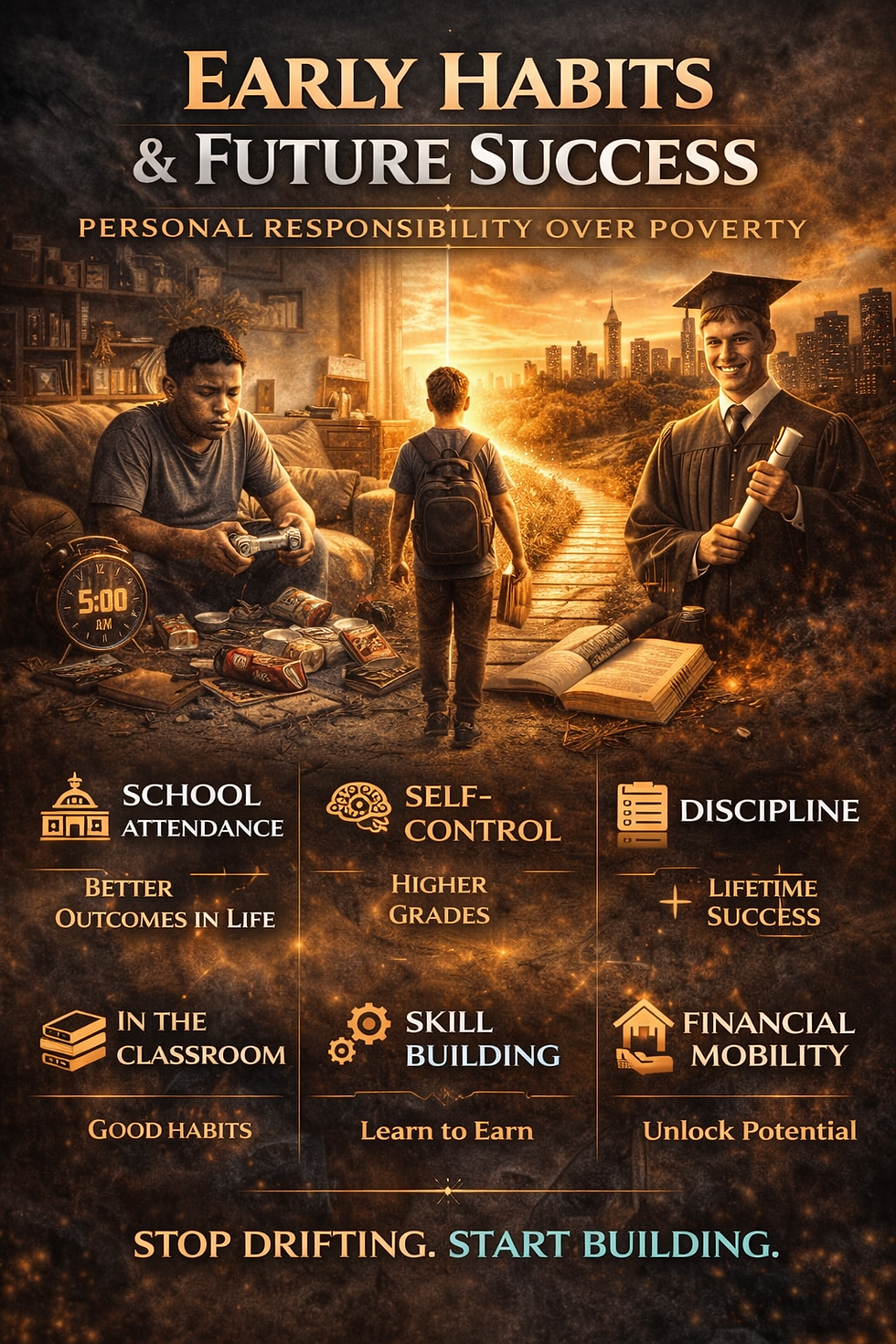
The First Derailing Force: Normalised Low Effort
One of the most perilous things a teenager can learn is that inconsistency is normal. When a student repeatedly chooses the path of least resistance – late work, low focus, chronic distraction and weak follow-through – that pattern can become their identity. OECD’s Survey on Social and Emotional Skills found that skills like persistence, curiosity, emotional control and responsibility are linked to grades, aspirations and well-being.
This is important because repeated under-effort is rarely just “school work”. It becomes a way of approaching life: delay, excuse, avoid and repeat. Brookings has argued that behaviour matters in poverty and mobility discussions, even while structural conditions also play a role.
⸻
School habits often transition into adult habits much quicker than people realise. By the time many leave high school, they’ve already practised adulthood for years. They’ve honed either punctuality or lateness focus or distraction discipline or avoidance. Brookings research on middle-childhood success revealed that children with strong academic and social skills by age 11 were far more likely to graduate well and avoid later poverty.
This explains why “I’ll get serious later” is such a costly lie. Later is usually built on earlier practice. Training yourself to quit when things feel boring hard embarrassing or slow doesn’t protect you it conditions you. It’s not destiny but trajectory.
⸻
Absenteeism Is a Serious Problem
Many derailments begin with a seemingly minor behaviour: not showing up. CDC reports link chronic absenteeism to poorer academic performance lower engagement and increased dropout risk. By middle school, it’s strongly associated with failing to graduate high school and reduced post-secondary participation.
This doesn’t mean every absent student is irresponsible; illness disability family instability and transport problems are real. The CDC explicitly acknowledges health-related causes. However when absenteeism becomes habitual rather than unavoidable it’s a clear early sign that a person is losing the structure needed for adult competence.
⸻
What People Call “Laziness” Often Involves a Cluster of Trainable Behaviours
People often label “laziness” as a single trait but it’s usually a cluster of trainable behaviours. These behaviours can be developed and improved with practice and effort.
“Lazy” is a blunt term. In reality, it often describes a cluster of behaviours: low persistence, poor self-control, poor planning, avoidance of discomfort and a preference for immediate rewards over delayed ones. OECD’s social-emotional skills data links persistence and emotional control to better academic outcomes and aspirations. NBER research also demonstrates that interventions targeting character, cognition and social-cognitive skills can enhance later educational outcomes.
This is actually good news. These behaviours and skills are trainable. A teenager who drifts isn’t broken but they need to stop romanticising underperformance as a defining personality trait.
⸻
Why Financial Struggles Often Begin Before a First Paycheck
People often think financial failure starts with adult money decisions. However, it often begins earlier with the habits that shape skill-building. Individuals with weaker education and skills face lower wages and fewer job prospects, a point Brookings highlights in its work on poverty in America. OECD similarly shows a link between education levels and later social and economic outcomes.
So when a student repeatedly neglects learning discipline and attendance, they’re not just lowering their grades. They’re potentially reducing their future bargaining power in the labour market. Less skill usually means less leverage. Less leverage usually means less income, fewer options and more resentment towards those who worked harder earlier.
⸻
Envy Often Grows Where Agency Has Been Neglected
When people consistently choose comfort over growth, they often watch others surpass them. If they don’t honestly examine their own habits, envy becomes the easier explanation: they got lucky, the world is unfair or they never had a chance. While the world can be unfair, envy becomes particularly corrosive when it hides avoidable self-betrayal. Brookings’ work on behaviour and poverty argues that both structure and personal conduct must be taken seriously.
The empowering reframe is that your past patterns explain you but don’t define you. The same compounding effect that can devastate a life can also rebuild it. This isn’t slogan thinking; it’s based on evidence that social-cognitive and educational interventions improve outcomes.
⸻
What Early Discipline Actually Protects You From
Discipline in youth isn’t about pleasing teachers; it protects future freedom. Strong habits improve graduation chances, skill acquisition, healthier behaviour and better job prospects. The CDC links healthy behaviours to academic achievement and Brookings connects early academic and social competence to better later outcomes.
Simply put, discipline now reduces chaos later. A student who learns to sit down focus finish ask for help and repeat builds more than grades; they build the machinery for adulthood: follow-through reliability and earned confidence.
⸻
The Strongest Argument Against the “Lazy Path”
The lazy path feels easy only in the short term. It saves effort today by borrowing pain from tomorrow. Skipping study missing school avoiding challenge and living on impulse may seem harmless in adolescence but they can limit options before independent life even begins. Research shows high-impact tutoring and social-cognitive support improve academic outcomes among adolescents demonstrating that effort and support can alter trajectories.
So the question isn’t whether effort matters; it does. The real question is whether someone will act early enough to benefit from compounding rather than suffering from it.
⸻
A Better, More Accurate Standard
The accurate message isn’t “poor people chose poverty.” That’s too simplistic and the evidence doesn’t support it as a universal claim. A better message is:
You may not control your starting point but ignoring your habits can worsen it.
You may inherit disadvantages but drifting will amplify them.
You might have been undertrained, unsupported or distracted, but responsibility is still the key to shaping your future.
This is a tougher message, but it’s more helpful because it addresses two common misconceptions: the idea that everything is your fault and the notion that nothing is.
⸻
A Direct Re-Evaluation for the Reader
Take a close look at your own patterns.
Do you keep your promises? Do you show up? Do you finish tasks when they lose their appeal? Do distractions control your life? Do you secretly blame avoidance on your personality? Are you building skills or excuses?
These questions matter because your habits aren’t just background noise; they’re a predictor of your future. OECD research shows that persistence curiosity and emotional control are closely linked to better outcomes.
You’re not reading this to feel judged. You’re reading this to break free from stagnation. You’re allowed to stop rehearsing your weaknesses and become the person who follows through. You’re allowed to replace envy with competence and start before you feel ready.
These aren’t magical affirmations; they’re practical decisions.
⸻
Conclusion
Poverty isn’t always a choice. Denying this overlooks significant evidence about inequality, health, education and opportunity. However, passive decline is often a choice, especially when repeated over years through absenteeism, low effort, poor self-control and a refusal to develop skills.
The positive news is that patterns learned early can be unlearned. A student who drifted can become an adult who executes. A teenager who hid behind laziness can become someone who builds leverage. Even a life that seemed headed towards resentment can turn towards discipline, skill and agency. Research on tutoring, social-cognitive support and social-emotional skills all point to the same conclusion: trajectories can change.
The sooner you stop negotiating with your own avoidance, the sooner your life starts to improve.

Comments